Let’s Just Explore the Vibe, Bro: The Prescience of Certain Proper Nouns in Thomas Pynchon’s Against the Day
by Luke Dylan Ramsey
Ah, the shitty parties and torpid hangovers of my youth, back when I had only heard of but never actually read anything by Thomas Pynchon, back when I was living and dying at the same damn time… ah, glory days…?
Yes, I most likely said the first part of this piece’s title out loud to a friend or three at least once, (en)during my personal collegiate vision quest. The likelihood percentage here is high, and so was I, most likely. Yes indeed, to steal a phrase as it were: we did truly feel like we were the 21st century ambassadors of peace and magic.
To risk it all: the word vibe is itself kind of a vibe. Or it has become one, rather.
Stop associating with the vibes, man
Stop dissociating from the vibes, bro
An alternate title for this essay could have been “Is the Word ‘Vibe’ Having a Moment?” but that type of headline would have been more befitting in the late 2010s, a more innocent time for many and especially me, as that was before I met a pair of women who would go on to ruin my life and—
Ahem, I digress. Anyway, there is no doubt that for the last decade or so the word vibe has been used far more than it ever has, even during the 1960s, the word’s initial heyday.
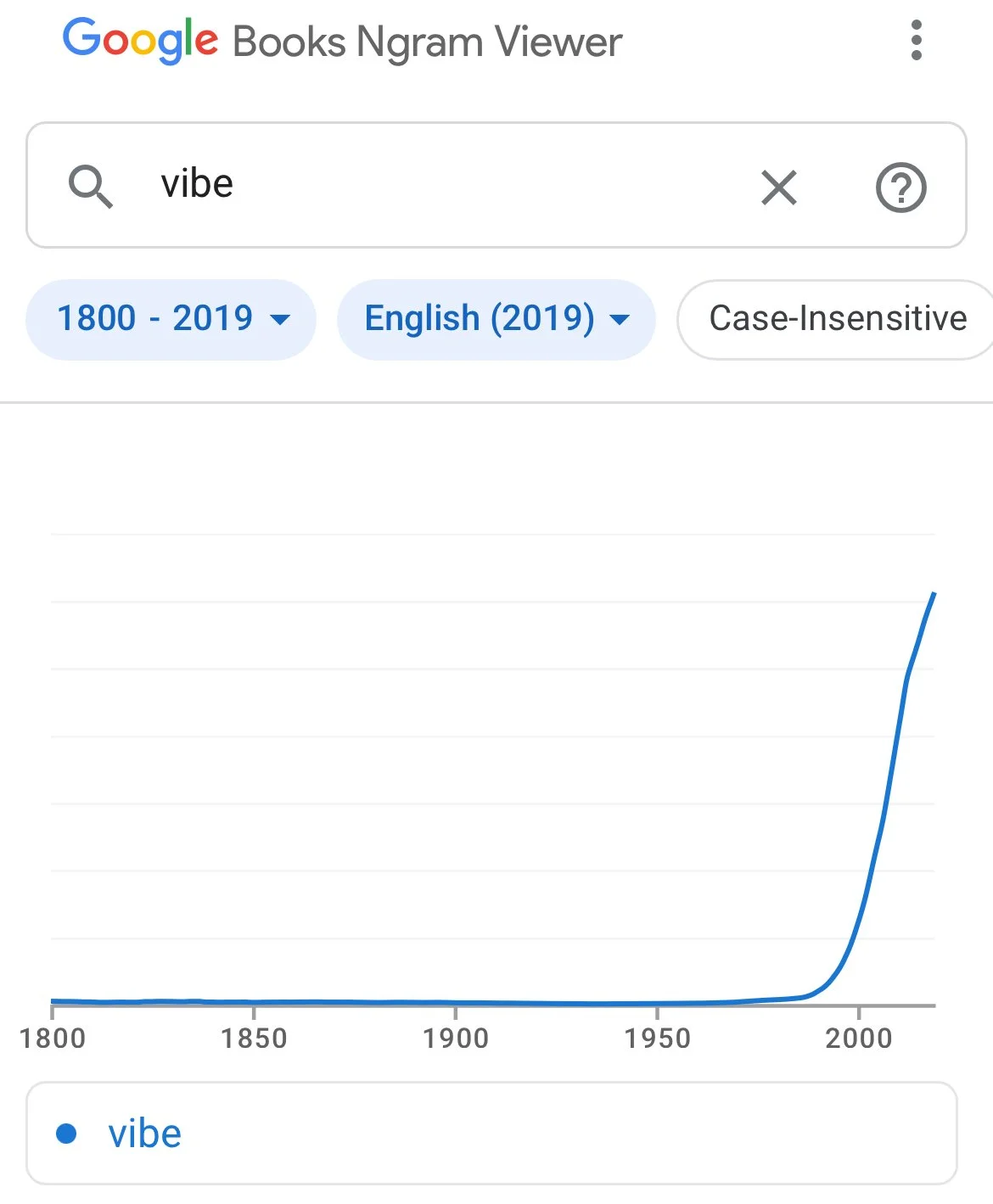
As this beautiful graph shows you, the vibes are getting higher and higher as society itself deliquesces into a fractured and fatuous Slough of Despond.
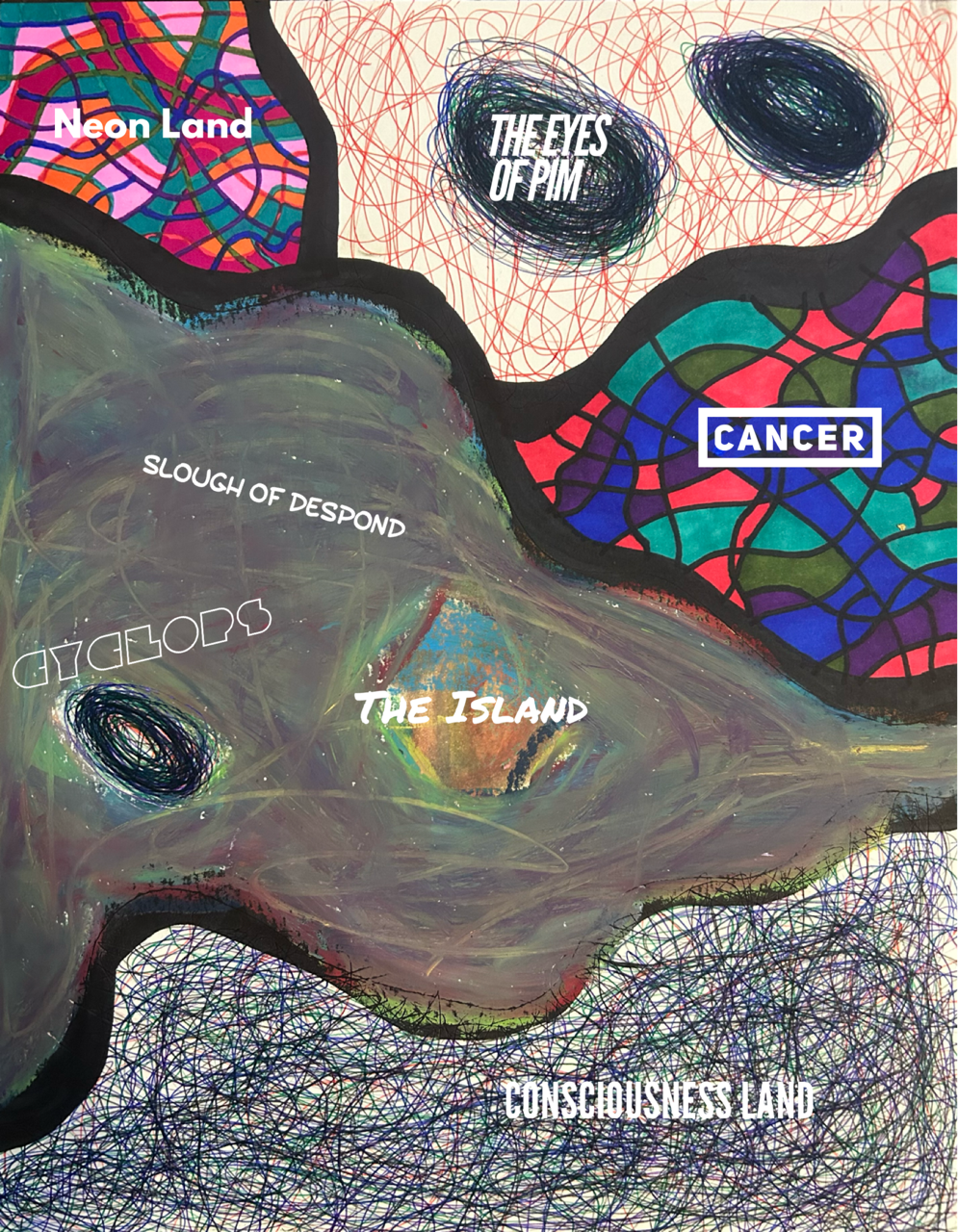
But what does any of this have to do with Thomas Pynchon, or, as he is known around my condo, Tortoise Pisshole?

The vibes always arrive
The vibes are in the air
The word vibe is all over Pynchon’s longest tome, Against the Day, although not in the way that you might think. Instead of a groovy narrator spewing out countercultural platitudes a la Pynchon’s (and PTA’s) Inherent Vice, we get the word vibe as a recurring and quite important proper noun.
Indeed, the proper noun “Vibe” belongs to a rich and powerful family that serves as a sort of MacGuffin for many (and maybe most) of the subplots in Against the Day (a book that is itself basically a collection of subplots). Besides reinforcing the seeming fact that the 60s will always define Pynchon’s oeuvre no matter how far afield he wanders from that decade, I am not sure there is all that much to explore about the word being employed as a proper noun.
However, that being said, as the Pynchon Wiki points out, the first name of the Vibe family patriarch, Scarsdale, is the name of one of New York City’s most affluent suburbs. The name could stem from some kind of scenario like the following: Pynchon is walking the streets of New York (where he currently resides), perhaps on his way to grab a slice of pizza, and he overhears someone saying, “I mean, he had a sort of Scarsdale vibe about him.” The name does also seem to imply that the Vibes are as old money as a family can get in America.
Another Vibe is Scarsdale’s son, Colfax, who gets the second most screen time of any of the Vibes early in the novel. Besides being the name of a vice president (who was a member of the quite Pynchonian “Independent Order of Odd Fellows”), Colfax is the name of a prominent street in Denver, Colorado (mentioned at least once in Against the Day) and a small town in central California (perhaps not coincidentally located not terribly far from where much of Vineland takes place). So what is a Colfax kinda vibe, then? You tell me, I guess, but it could mean something like a person has a sort of small town feel about them… although Colfax the character is not depicted as having that sort of… vibe.
I’ve had enough of this vibe
I’m not vibing with this anymore
Anyway, Cragmont is another Vibe mentioned in the novel, and like his father, his name is also the name of a wealthy neighborhood, this time located in Berkeley, California. Again like his father, somebody could have a Cragmont vibe to them: rich, quite possibly snooty, probably an asshole.
As for the female Vibes, I do not make much of Dittany’s name, plus she is a minor character who appears in only one chapter. Edwarda (Scarsdale’s wife and therefore the matriarch of the family), however, could possibly be linked to a short story by Georges Bataille.
Bataille, if you are familiar with him, is fairly obviously one of Pynchon’s forebears in the depicting transgressive sexual acts department… although I cannot be sure that Pynchon has read or is aware of Bataille, I would be greatly surprised if he had not read at least one or two stories by the French writer.
The short story in question is called “Madame Edwarda” and it involves a man encountering a prostitute named Edwarda who reveals that she is actually God. God being female is certainly an idea of which Pynchon would approve, and I am pretty sure Pynchon would find the concept of God embodying a female prostitute kinda hilarious. Is there something deeper there, though? Could Pynchon be implying that Edwarda Vibe was a prostitute before she met Scarsdale? Or, heaven forbid, was her job how she met Scarsdale? I do not believe there is basically any textual evidence for this, but it is certainly a fun theory.
Bataille wrote introductions to many of his stories; and he did so for “Madame Edwarda”. The intro is chock full of sentiments that Pynchon assumedly would approve of, but I did find one part of the introduction particularly salient when viewed through the lens of Pynchon’s overall project: “The most ordinary social restrictions and prohibitions are, with equal force, aimed some against sexual life, some against death, with the result that each has come to comprise a sanctified domain, a sacred area.” The sex drive and the death drive are two of Pynchon’s main obsessions, and he would certainly agree with Bataille’s sentiments.
What is a vibe, anyway?
Can’t you feel the vibes, bro?
As for Fleetwood Vibe, like Dittany, I do not make much of his name. Could it be a reference to Fleetwood Mac? Yes, but that seems too obvious. Could it be a reference to Fleetwood, a town on the western coast of England? Sure, but I cannot find any connection between Pynchon (or Pynchon’s ancestors) and that particular area of England. I guess a musical act could have a Fleetwood sorta vibe to them, as in they are paying homage to or just ripping off Fleetwood Mac… as you can see, I am struggling here.
The final Vibe we will be exploring today is one Wilshire Vibe. There are a few different references Pynchon could be making with the name. Like Colfax, Wilshire is a prominent street in a major US city (this time in Los Angeles, California). Also like Colfax, Wilshire is the surname for a Reconstruction era American politician. Wilshire in the novel is a bit of an outlier, in that he is the only Vibe who seems at all interested in the arts, and Wilshire Boulevard is the street on which the LACMA is located. The name could be a reference to Gaylord Wilshire (Wilshire Boulevard’s namesake), a famous leftist and land developer (but ain’t those two things kinda contradictory?) who spent most of his life in southern California. Wiltshire is an area of England, like Fleetwood, and it does notably contain Stonehenge (Pynchon explores the existence and nature of ancient human-made monuments in Mason & Dixon, for example). However, I am struggling yet again to come up with a concrete reason for the name, so let’s move on.
This is not my sorta vibe, man
What kinda vibes are these, bro?
I am sure at least one or two of you are wondering how Pynchon at all relates to this magazine’s twinned obsessions: science fiction and horror. Well, Pynchon includes elements of science fiction in pretty much every one of his novels, and Gravity’s Rainbow (Pynchon’s most direct homage to sci-fi) was somewhat infamously nominated for (and should have won) a Nebula Award. As for horror, Pynchon does seem to have a love for cosmic horror: his repeated portrayals of conspiracies so vast and intricate that no single human could ever understand them do bring to mind beings like Lovecraft’s Cthulhu. And there are almost always one or two scenes in his novels that could be called horror or at least horror adjacent.
In the coming months—barring any unforeseen developments such as alien invasion, the outbreak of World War Three, and/or the return of Jesus Christ—I may or may not be exploring a great many different things. What are those things? Well… I am no prophet, nor am I a noted futurist or prognosticator, so….
Also, if you are interested in more Thomas Pynchon content, check out the podcast I co-host: Mapping the Zone, available wherever you listen to your podcasts (including YouTube).